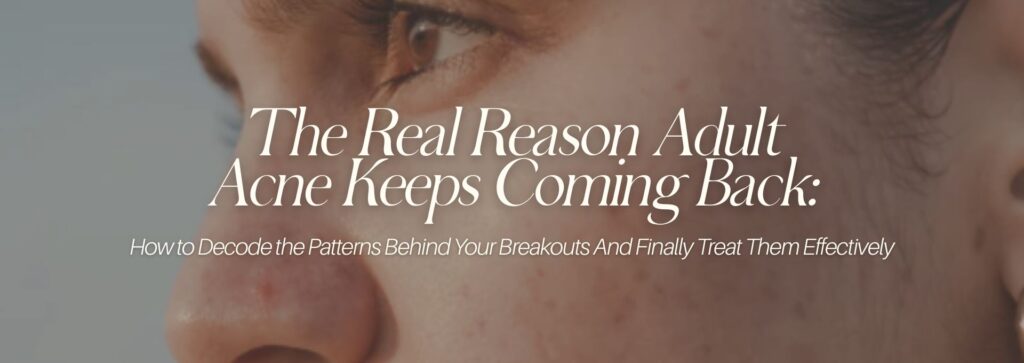
If acne were simply about clogged pores or “bad skin,” most adults would have outgrown it years ago.
Instead, breakouts persist well into our 30s, 40s, and beyond—often changing their location, timing, and behavior over time. One month it’s jawline congestion flaring before your cycle. Another, it’s inflamed papules across the cheeks after a period of stress, travel, or dietary change. Sometimes your skin tolerates everything. Sometimes it reacts to products you’ve used for years.
What makes this especially frustrating isn’t just the acne—it’s the dismissal.
You’re told it’s stress. Or hormones. Or aging. Or something to manage with stronger products, antibiotics, or another peel. You try. It improves briefly. Then it returns, often worse.
At Brain Body Well, we see this pattern constantly. And we know the problem isn’t your effort—it’s the framework being used.
Adult Acne Is Not One Condition—It’s a Set of Patterns
One of the most persistent myths about acne is that it has a single cause.
In reality, adult acne reflects overlapping physiological patterns that express themselves through the skin. In our clinical work, we most often see three dominant profiles—frequently coexisting rather than appearing in isolation.
Hormonal Pattern Acne
Typically concentrated along the jawline, chin, neck, or lower face, this pattern often fluctuates with:
- Menstrual cycle timing
- Perimenopause
- Metabolic or insulin stress
Barrier-Impaired Acne
Here, the skin is reactive and easily overwhelmed.
- Products sting or burn
- Breakouts worsen after treatments meant to help
- Inflammation escalates quickly
When the protective barrier is compromised, even “good” products can trigger flares.
Microbiome-Driven Acne
This pattern reflects imbalance on the skin—and often in the gut.
- Persistent congestion
- Uneven texture
- Flares after antibiotics, illness, or dietary shifts
Understanding which patterns are active changes everything. Once you identify the pattern, your skin’s behavior starts to make sense.
What Your Skin Is Communicating Beneath the Surface
Your skin doesn’t exist in isolation. It mirrors how multiple internal systems are functioning together.
Some of the signals we pay close attention to include:
- Energy rhythms: wired-but-tired, afternoon crashes, poor recovery
- Digestive patterns: bloating, irregular stools, food sensitivities
- Stress reactivity: flares during emotional or cognitive overload
- Timing: breakouts linked to cycles, travel, or sleep disruption
- Product sensitivity: reactions to retinoids, acids, or “active” routines
- Lesion type: closed comedones versus inflamed papules or cysts
These are not random observations.
They are data points—and when viewed together, they reveal which systems need support first.
Why Spot Treatments and Quick Fixes Fail Long Term
Most acne regimens don’t fail because they’re ineffective.
They fail because they’re applied without sequence or strategy.
Common mistakes we see:
- Over-exfoliating already inflamed skin
- Using retinoids on a compromised barrier
- Layering aggressive treatments without addressing internal drivers
Even well-intentioned interventions—facials, peels, antibiotics, topical prescriptions—can backfire when used out of order.
The result?
Temporary improvement. Then relapse. Then loss of trust.
The Glow Well Approach: Regenerative, Not Reactive
At Glow Well, we approach acne as a regenerative process, not a cosmetic problem to suppress.
Our framework respects the body’s hierarchy of needs.
We begin with barrier restoration, because calm skin responds better to everything else. From there, care is layered intentionally to address:
- Hormonal pattern mapping and cycle awareness
- Microbiome repair (topical and internal)
- Nutrition and insulin balance without restriction or rigidity
- Stress load and nervous system regulation, which directly affect inflammation
- Targeted topical prescriptions and regenerative support, timed correctly
This isn’t about doing more.
It’s about doing things in the right order.
What Acne Recovery Actually Looks Like
Clear skin doesn’t happen overnight.
Early phases may include subtle flares as systems recalibrate. Texture often improves before lesions resolve. Consistency—not intensity—creates stability.
When care is structured and responsive:
- Breakouts become less reactive
- Patterns stabilize
- Skin becomes predictable
- Decisions feel grounded instead of desperate
That’s recovery.
If you’re ready to understand why your skin behaves the way it does—and what it actually needs next—we invite you to schedule a consultation and explore the Glow Well Integrative Acne Recovery Program.
Book Your Glow Well Acne Consultation